The Honest Perfume Performance Comparison Guide: How to Truly Test Longevity, Projection, and Value
A thorough perfume performance comparison is the only way to separate marketing hype from the fragrances that actually deliver. Quick answer: To accurately compare perfume performance, you must test a fragrance on your bare skin across its entire chemical lifecycle. This requires evaluating the initial opening, the heart notes, the final dry-down, its total longevity in hours, its projection radius, and its true value based on how and where you plan to wear it.
The fragrance market is currently flooded with exaggerated claims of “beast mode” performance, “24-hour” staying power, and hyper-concentrated formulas. Navigating this landscape without a structured testing method often leads to expensive buyer’s remorse. If you truly want to avoid wasting money, learning how to read and evaluate perfume reviews like a pro is your first essential step.
In this comprehensive guide, we will walk you through the exact editorial and scientific framework we use to test fragrances. By the end, you will be equipped to evaluate scents with the precision of a seasoned beauty editor, ensuring you never settle for a fleeting fragrance again.
The Essential Framework for a Perfume Performance Comparison
Understanding a fragrance goes far beyond deciding if you like the smell straight out of the tester bottle at a department store. A true evaluation requires patience, controlled variables, and a highly structured approach. Perfumes are complex chemical mixtures composed of volatile molecules that evaporate at vastly different rates.
This means the beautiful, bright scent you smell at minute one is rarely the scent you are left with at hour six. When we conduct a full, publish-ready review, we follow a strict sequential framework. That sequence is: Scent Profile, Opening, Heart, Dry-down, Longevity, Projection, Occasion, Value, and Final Verdict.
By breaking down the evaluation into these specific, measurable phases, you can accurately compare two or more competing fragrances side-by-side. Let’s explore how to rigorously test and compare each stage effectively, ensuring you know exactly what you are paying for before you commit to a full bottle.
Phase 1 of Your Perfume Performance Comparison: Analyzing the Opening
The first impression of a fragrance is deliberately designed to captivate you and drive an immediate sale, but it is also the most fleeting part of the experience. To conduct a reliable perfume performance comparison, you must learn to look past this initial blast of alcohol and volatile top notes.
Defining the Core Scent Profile
Before you can accurately assess performance, you must first understand the overarching scent profile you are dealing with. Is it a fresh aquatic citrus, a deep woody oriental, or a heavy, sweet gourmand? Categorizing the fragrance helps set realistic, science-based performance expectations.
For instance, light citrus notes like bergamot and lemon inherently evaporate much faster than dense resins, vanillas, or musks. To better understand these categories and why they behave differently, explore our detailed guide on how to read, understand, and master scent layers.
Evaluating the Top Notes
The opening, commonly referred to as the top notes, typically lasts anywhere from five to fifteen minutes. This phase is usually bright, sharp, highly volatile, and heavily reliant on lighter molecules. When comparing two perfumes side-by-side, your testing method must be flawless.
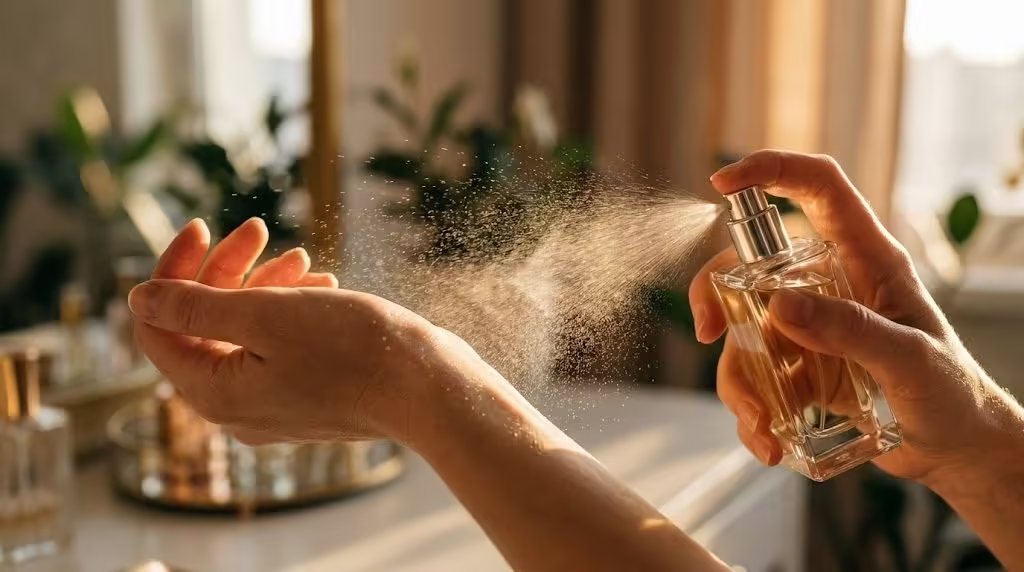
- Spray each fragrance on a different wrist or forearm (never rub your wrists together, as friction creates heat that aggressively burns off top notes).
- Wait at least 30 seconds for the perfumer’s alcohol to evaporate fully before taking your first sniff, otherwise you will temporarily numb your receptors.
- Note the immediate quality and intensity: does the opening smell synthetic, harsh, and screechy, or does it feel smooth, natural, and well-blended?
Phase 2: The Heart and The Dry-Down Evaluation
Once the flashy top notes dissipate, the true character of the fragrance finally emerges on your skin. This is where a perfume performance comparison becomes truly revealing, as many cheaper or poorly formulated fragrances completely fall apart during these middle and base stages.
Experiencing the Heart Notes
The heart (or middle) notes form the core identity and emotional theme of the perfume, typically lasting for two to four hours. This is the scent that people around you will notice most during a lunch date, a commute, or a business meeting. Heart notes often consist of florals like rose and jasmine, or spices like cardamom and cinnamon.
A high-quality fragrance will transition smoothly and seamlessly from the opening into the heart. It should maintain its structural balance and complexity without turning overly powdery, metallic, or soap-like. When comparing two scents, pay close attention to which one retains its distinct character rather than muddying into a generic blur.

Assessing the Dry-Down
The dry-down is the final, longest-lasting phase of a fragrance’s lifecycle, dominated by heavy base notes like vanilla, amber, musk, patchouli, and woods. This is the skin-scent that lingers on you at the very end of the day. Because these molecules are large and heavy, they evaporate incredibly slowly.
According to the safety and formulation standards set by the International Fragrance Association (IFRA), the specific molecular weight of these base ingredients directly determines their maximum staying power. When comparing the dry-down of two perfumes, ask yourself a simple question. Does the scent retain a pleasant, comforting aroma, or does it degrade into a generic, flat chemical smell?
The Role of Aroma Chemicals
Modern perfumery relies heavily on aroma chemicals like Ambroxan and Iso E Super to extend the life of a dry-down. These synthetic molecules are brilliant at anchoring lighter notes to the skin, but they can also be overwhelming if overused. During your comparison, note if the late-stage dry-down feels excessively synthetic or if it fades with grace.
Phase 3: Perfume Performance Comparison Metrics – Longevity and Projection
This is arguably the most critical stage of any thorough fragrance evaluation. While scent preferences are entirely subjective, longevity and projection are measurable, objective metrics that directly impact a luxury product’s financial worth.
Measuring True Longevity
Longevity refers strictly to the total amount of time a fragrance remains detectable on your skin. To test this accurately, you must track the scent in a normal day-to-day environment, not just in the climate-controlled, scent-heavy air of a boutique. Concentration levels play a massive role here, which is why understanding eau de parfum vs eau de toilette formulations is vital for setting your expectations.
- Short-lived: 2–4 hours (Typical behavior for summer colognes, light EDTs, and citrus-heavy profiles).
- Moderate: 5–7 hours (The standard baseline for most modern designer EDPs).
- Long-lasting: 8 to 12+ hours (Usually found in extraits, pure parfums, and heavy niche scents featuring oud or dense ambers).

Evaluating Projection vs. Sillage
Many consumers confuse projection with sillage, but they are two distinct phenomena. Projection is how far the scent physically pushes off your resting skin into the air around you. Sillage, on the other hand, is the invisible, lingering scent trail you leave behind when you walk through a room.
A fragrance can have massive longevity but sit very close to the skin (an intimate scent), or it can project across a room aggressively for two hours before vanishing completely. You can learn more about mastering this delicate balance in our dedicated guide to perfume longevity and projection.
How to Test Projection Accurately
Apply the fragrance and ask a friend or partner to stand an arm’s length away after 30 minutes, and then again after two full hours. If they can smell you clearly without leaning in, the perfume has strong projection. While community databases like Fragrantica offer excellent crowdsourced data on projection, testing it on your unique skin chemistry is the only definitive method.
The Threat of Olfactory Fatigue (Nose Blindness)
One of the biggest hurdles in a perfume performance comparison is olfactory fatigue, commonly known as nose blindness. Your brain is hardwired to ignore constant stimuli to protect you from sensory overload. If you wear a heavy fragrance, your nose may simply stop registering it after an hour, tricking you into thinking it has faded.
Before leaving a negative review claiming a perfume has poor performance, always ask someone else if they can still smell it on you. For deeper insights into how our noses process and eventually ignore smells, resources from The Fragrance Foundation offer fascinating educational materials on olfactory science and adaptation.
Phase 4: Matching Occasion, Chemistry, and Value
Raw performance metrics are essentially meaningless without real-world context. A fragrance that projects heavily for 14 hours might be incredible for a loud nightclub, but it would be suffocating and inappropriate in a small, shared office space. A holistic evaluation always factors in practical utility.
Determining the Right Occasion
Every fragrance has a distinct vibe, temperature, and volume. Fresh, aquatic, and light floral scents with moderate longevity are ideal for daytime wear, professional offices, and gyms because they do not intrude on others’ space. Conversely, rich, heavy scents with massive projection are better suited for evening wear, cold winter weather, and outdoor events.
Evaluating a perfume strictly based on its intended occasion prevents you from unfairly judging a delicate, airy summer citrus against a dense, heavy winter amber. They are engineered for completely different purposes.
Skin Chemistry Variables
Your unique biological makeup alters how a perfume performs. People with naturally oily skin tend to hold onto fragrances much longer, as the oils trap the scent molecules. Conversely, those with dry skin will notice fragrances evaporate much faster.
If you struggle with poor longevity, the solution is often not to buy a stronger perfume, but to apply an unscented body lotion before spraying. To understand more about the biology behind this, we highly recommend reading our honest guide to fragrance science.
Calculating True Value and Cost-Per-Wear
Value in perfumery is not just about the retail price tag; it is fundamentally about the cost-per-wear and the performance yield of the juice. If a $50 affordable perfume requires ten sprays and constant reapplication every two hours, you will drain the entire bottle in a month.
If a $150 luxury perfume requires only two sprays and lasts all day with beautiful projection, the more expensive bottle is actually the better financial value. Always compare the price per milliliter against the required dosage to get the effect you desire.
| Fragrance Concentration | Average Expected Longevity | Best Suited Occasion | Overall Value Assessment |
|---|---|---|---|
| Eau de Cologne (EDC) | 2 – 3 Hours max | Post-shower, Gym, High Heat | Requires frequent, heavy sprays; low cost per ml but fast depletion. |
| Eau de Toilette (EDT) | 4 – 6 Hours | Office, Casual Everyday Wear | Excellent balance for daily, moderate, non-intrusive use. |
| Eau de Parfum (EDP) | 6 – 8 Hours | Evening, Date Night, Autumn | High value; requires fewer sprays and offers richer basenotes. |
| Extrait de Parfum | 8 – 12+ Hours | Special Events, Winter, Clubs | High upfront cost, but lasts forever on skin with minimal sprays. |
Common Mistakes During a Perfume Performance Comparison
Even seasoned fragrance enthusiasts can make errors when testing new scents. To ensure your comparisons are scientifically and practically sound, you must avoid these common pitfalls.
Testing Too Many Scents at Once
Walking into a boutique and spraying six different perfumes up your arms is a guaranteed recipe for olfactory confusion. Your nose simply cannot process that many competing chemical profiles simultaneously. Limit your testing to a maximum of two fragrances at a time—one on each wrist.
Testing on Paper Instead of Skin
Paper blotters are fantastic for getting a general idea of the top notes, but they are terrible for testing longevity. Paper lacks human body heat, natural oils, and a unique pH balance. A fragrance will always last longer and smell more linear on a blotter than it will on a living, breathing human body.
Falling for the Maceration Myth
Many people believe that if a perfume performs poorly, leaving it in a dark closet for six months to “macerate” will magically turn it into a beast-mode projector. While slight oxidization can smooth out rough edges over time, a weak formula will always be a weak formula. We dive deep into this and other misconceptions in our article, Perfume Myths Debunked: 7 Honest Truths Every Fragrance Lover Needs to Know.
The Final Verdict: Mastering the Perfume Performance Comparison
When you finally reach the verdict stage of a perfume performance comparison, you must synthesize everything you have observed across the day. Does the exceptionally beautiful opening justify the disappointingly weak dry-down? Does the massive, room-filling projection justify the exorbitant price tag?
Ultimately, a successful fragrance purchase is one that aligns perfectly with your specific lifestyle needs, skin chemistry, and budget. By systematically breaking down your evaluation into Scent, Opening, Heart, Dry-down, Longevity, Projection, Occasion, and Value, you completely remove the guesswork and the marketing hype from the equation.
Key Takeaways
- Never judge a perfume solely by its top notes; you must wait at least two hours to experience the true dry-down.
- Always test fragrances on your own bare skin, as body chemistry drastically alters both longevity and projection.
- A high retail price does not automatically guarantee long-lasting performance or high-quality ingredients.
- Consider the occasion: “beast mode” projection is not always desirable and can be rude in close-quarter environments.
- Calculate value based on the number of sprays required per wear, not just the upfront bottle price.
Ready to put these analytical skills to the test and find your ultimate signature scent? We invite you to explore more of our honest, hype-free reviews, deep-dive guides, and tutorials at Golden Hour to continue building a fragrance wardrobe you truly love.
Frequently Asked Questions
How do you compare two perfumes accurately?
To compare two perfumes accurately, spray one on your left wrist and the other on your right wrist, ensuring you apply the exact same number of sprays. Evaluate them simultaneously throughout the day, noting how the scent profile changes from the opening to the dry-down, and record which fragrance fades first.
Why does a perfume perform differently on paper than on skin?
Perfume performs differently on paper because paper lacks heat, natural sebum oils, and the unique pH balance of human skin. A fragrance tested on a blotter will often retain its top notes much longer and smell more linear, whereas testing on skin reveals how the scent truly evolves and degrades.
Does a higher concentration always mean better longevity?
A higher concentration generally improves longevity, but it is not an absolute rule. The specific molecular weight of the ingredients matters just as much; a heavy Eau de Toilette built with dense woods and resins can easily outlast a light Eau de Parfum made entirely of volatile citrus notes.
How can I improve the performance of a weak perfume?
You can dramatically improve a weak perfume’s performance by thoroughly moisturizing your skin with an unscented lotion or body oil before applying the fragrance. Additionally, spraying on pulse points, as well as on your clothing or hair, can help trap the scent molecules and extend overall longevity.
What is the difference between longevity and sillage?
Longevity measures the total amount of time a fragrance remains detectable on your skin, from the first spray to the final fade. Sillage refers strictly to the invisible scent trail you leave behind in the air as you walk. A perfume can have excellent longevity but very low sillage.
Are “beast mode” fragrances worth the investment?
Beast mode fragrances are worth the investment only if you frequent environments that require heavy projection, such as crowded nightclubs or outdoor winter events. For daily office wear, gym sessions, or intimate settings, excessively strong fragrances are often overwhelming and can cause headaches for those around you.