How to Choose Women’s Perfume for Everyday Wear: The Ultimate Honest Guide
Finding a reliable signature scent can feel overwhelming when every bottle promises luxury while social media feeds push conflicting trends. Choosing the right women’s perfume for everyday wear requires balancing your personal routine, skin chemistry, and fragrance concentrations without falling for marketing hype. Whether you navigate busy office spaces, university lecture halls, or casual weekend errands, your daily scent should feel like a natural second skin rather than an overpowering statement.
Quick answer: The best women’s perfume for everyday wear features a balanced Eau de Toilette or Eau de Parfum concentration with breathable top notes like bergamot or neroli, a soft floral or aromatic heart, and a clean base of white musk or cedarwood that lasts six to eight hours without overwhelming close quarters.
To build a daily rotation that performs reliably across changing seasons, start by exploring our comprehensive Golden Hour pillar guide, where we break down fragrance families, longevity tests, and practical scent layering techniques.
What Makes a Great Women’s Perfume for Everyday Wear?
An ideal everyday scent strikes a delicate balance between gentle projection and noticeable longevity. Unlike dramatic evening fragrances built around heavy oud, syrupy amber, or dense animalic musks, a daytime fragrance relies on clean, breathable accords that uplift your mood without fatiguing your senses or bothering those around you.
When selecting your daily rotation, consider how the fragrance interacts with your immediate environment. High humidity, air-conditioned workplaces, crowded public transit, and physical activity all alter how aromatic molecules evaporate from your skin. Versatility is essential, meaning the composition should transition smoothly from morning productivity to casual evening relaxation.
Furthermore, understanding how different fragrance concentrations affect performance helps you avoid over-applying heavy extraits when an eau de toilette or eau de parfum provides the ideal daytime aura. A well-chosen daily scent enhances your confidence quietly, acting as a comforting personal companion throughout your daily routine.
Understanding Sillage and Intimate Scent Bubbles
In perfumery, sillage refers to the scented trail a fragrance leaves behind in the air as you move, while projection describes how far the scent radiates outward from your skin. For daily wear, moderate projection that stays within an arm’s length creates a polite, inviting presence rather than filling an entire conference room.
Fragrances designed for close-quarters comfort often rely on modern aroma chemicals like Iso E Super, Ambroxan, and clean macrocyclic musks. These molecules create a radiant, skin-like warmth that ebbs and flows gently throughout the day rather than projecting aggressively during the first hour and vanishing by lunch.
Adapting to Climate, Humidity, and Indoor Air
Ambient temperature and humidity dramatically change how a perfume behaves once sprayed. In warm, humid climates across South Asia or the Middle East, heat accelerates the evaporation of volatile top notes while amplifying sweet, heavy base notes, which can quickly turn a rich gourmand fragrance cloying.
Conversely, dry air-conditioned offices or cool autumn mornings slow down evaporation, allowing crisp citrus, green tea, and sheer floral notes to linger longer on the skin. Evaluating a fragrance in the exact climate and indoor conditions where you spend most of your week prevents costly blind-buy mistakes.

Decoding Scent Families for Women’s Perfume for Everyday Wear
Navigating established fragrance families helps narrow down what genuinely works on your skin before you step up to a fragrance counter. Not all olfactory profiles perform equally during daylight hours, making it essential to understand which families excel in casual, academic, or professional settings.
Fresh citrus, aquatic, and crisp green accords open with instant brightness, energizing your morning routine right after your shower. Meanwhile, gentle floral hearts and soft woody or musky bases provide warmth and structure as the afternoon progresses.
If you enjoy exploring specific profiles, you can learn more through our guides on fresh citrus perfume for women and green perfume for women. For those who prefer a touch of comforting sweetness without overwhelming heaviness, exploring a vanilla perfume for women offers refined, airy elegance.
Top Notes vs. Heart Notes for Daytime Wear
Top notes dictate your initial impression during the first fifteen to thirty minutes after spraying, featuring small, volatile molecules like Calabrian bergamot, Sicilian lemon, mandarin, and dewy pear. Because these molecules evaporate rapidly, they deliver an immediate burst of freshness without weighing down the rest of the composition.
Heart notes—also called middle notes—emerge just as the citrus opening settles, defining the true personality of your daily fragrance for the next three to four hours. Common daytime heart notes include lily of the valley, peony, freesia, iris, and soft orange blossom, all of which provide a welcoming, approachable character.
Base Notes That Anchor Your Daily Scent
Base notes provide the structural foundation that keeps your perfume from disappearing entirely by midday. For everyday wear, look for clean white musks, cashmeran, Virginia cedarwood, sandalwood, and sheer ambergris substitutes that cling gently to skin and fabric.
To dive deeper into how individual raw materials interact with your personal body chemistry, read our detailed guide on how to choose your perfume by fragrance notes.
Balancing Sweet, Fresh, and Woody Accords
The most versatile daily perfumes rarely rely on a single flat note; instead, they pair contrasting elements so the scent stays interesting from morning until evening. A bright citrus opening balanced over a creamy sandalwood and white musk base gives you both morning energy and afternoon comfort.
When reading a fragrance pyramid, check that at least one grounding woody or musky note sits at the bottom. Without that anchor, purely floral or fruity compositions often fade within two hours, forcing you to carry a travel atomizer everywhere you go.
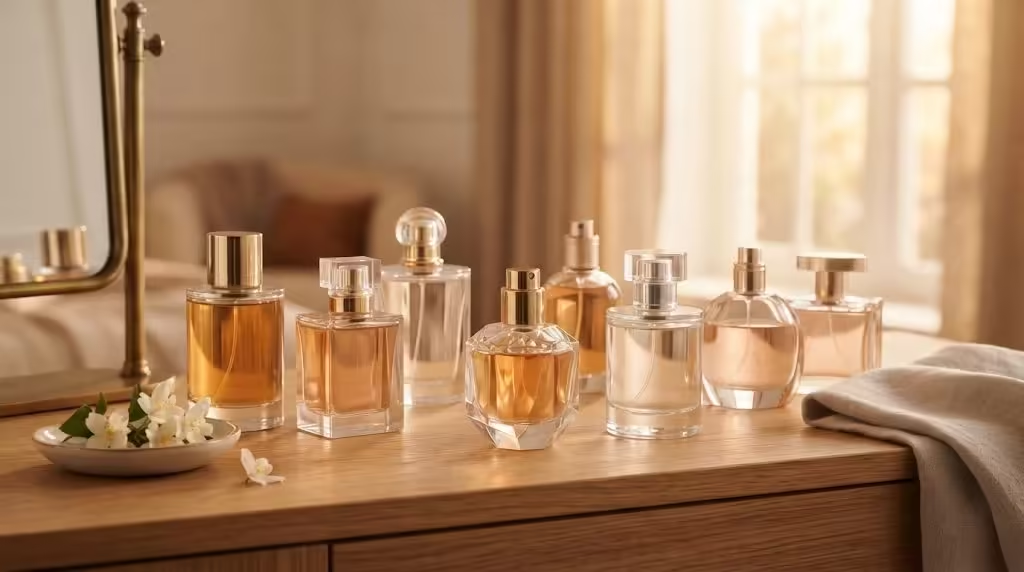
Comparing Everyday Fragrance Concentrations
Choosing the correct concentration ensures your perfume lasts through your workday without requiring constant reapplication or risking sensory overload. According to standard classifications outlined by Wikipedia’s overview of perfume concentrations, the percentage of aromatic compounds dissolved in ethanol and water directly governs both longevity and diffusion.
The comparison table below outlines how each standard concentration performs during typical daytime routines, helping you match the bottle strength to your schedule.
| Concentration Type | Aromatic Oil Percentage | Typical Longevity | Daytime Suitability |
|---|---|---|---|
| Eau de Cologne (EDC) | 2% – 4% | 2 – 3 Hours | Very refreshing, ideal for quick morning boosts or post-gym touch-ups |
| Eau de Toilette (EDT) | 5% – 15% | 4 – 6 Hours | Excellent for casual daytime errands, warm weather, and airy freshness |
| Eau de Parfum (EDP) | 15% – 20% | 6 – 8 Hours | Balanced longevity and moderate projection for office and everyday wear |
| Extrait / Parfum | 20% – 30%+ | 8 – 12+ Hours | Best reserved for evenings or single-spray winter wear due to high density |
While higher oil percentages generally last longer, formulation style matters just as much as concentration. A citrus-heavy Eau de Parfum may still fade faster than a wood-and-musk Eau de Toilette because citrus molecules are naturally lighter and more volatile.
If you want to maximize your fragrance budget, learning how oil ratios and molecular weights interact is vital. Read our detailed analysis on perfume longevity and projection to get the most reliable performance out of your daily bottles.
Matching Your Perfume to Your Lifestyle and Routine
Your daily schedule dictates your fragrance needs far more than viral social media trends ever will. A lively fruity-floral suited for remote work or relaxed weekend brunches might feel too loud in a quiet library, hospital ward, or shared corporate office.
Consider your daily commute, indoor workspace, and social interactions before committing to a full bottle. If you spend hours in close meetings, sheer musks, crisp green notes, and clean soapy florals communicate professionalism without invading anyone’s personal space. For structured workplace environments, our guide on the best office perfumes for women highlights compositions designed specifically for subtle elegance.
Aligning your scent choices with your broader weekly habits also prevents bottle clutter and decision fatigue. Refer to our insights on how to choose perfume by lifestyle to coordinate your fragrance wardrobe seamlessly with your everyday commitments.
Corporate Offices, Universities, and Shared Spaces
Shared indoor spaces require fragrance etiquette because scent sensitivities and mild allergies are common among coworkers and classmates. Choosing translucent compositions built around iris, white tea, neroli, or clean cedar ensures you smell polished and put-together without triggering headaches for the person sitting next to you.
In these settings, stick to one or two sprays beneath your clothing rather than spraying exposed wrists right before walking into a meeting. Fabric traps scent molecules gently, releasing a soft, controlled aroma whenever you move.
Casual Errands, Outdoor Walks, and Weekend Wear
Open-air environments give you much more freedom to enjoy sparkling citrus, dewy rose, crisp apple, or sun-warmed fig notes. Because outdoor airflow disperses scent molecules rapidly, an Eau de Toilette or light Eau de Parfum feels refreshing and effortless during weekend errands or coffee dates.
You can also use weekends to test new decants or sample vials in relaxed conditions, observing how a scent evolves over six hours without the pressure of a formal workday.
How to Test and Buy Authentic Everyday Perfumes Safely
Social media hype and counterfeit listings make shopping for fragrances online feel risky, especially when popular designer and niche bottles are frequently imitated. Testing methodically before buying a full-size bottle protects both your wallet and your skin.
Always test a prospective daily scent directly on your clean skin rather than relying solely on paper blotters. Paper strips hold top notes artificially long and never replicate how your natural skin lipids, body temperature, and pH transform the heart and base notes over several hours.
Furthermore, reputable fragrance houses formulate their scents in strict compliance with safety standards set by the International Fragrance Association (IFRA) to minimize skin sensitization and allergic reactions. Purchasing from authorized retailers or verified sample decant services guarantees you receive genuine, properly stored formulas rather than degraded or counterfeit liquids.
The Three-Stage Skin Test Method
When sampling a perfume in store or from a 2ml decant, apply two sprays to the back of your hand or inner forearm and resist the urge to judge it immediately. Follow these three checkpoints before making a purchase decision:
- The 15-Minute Check: Step outside the perfume store into fresh air once the alcohol evaporates so you can evaluate the true transition from top notes to heart notes without competing counter scents.
- The 3-Hour Midday Check: Notice whether the heart notes still feel pleasant and comfortable on your skin or if a specific floral or sweet ingredient becomes sharp or tiring.
- The 6-Hour Dry-Down Check: Smell your skin at the end of the afternoon to confirm that the lingering base notes feel clean, comforting, and worth wearing five days a week.
Spotting Counterfeits and Poor Storage
Counterfeit fragrances often feature slightly misaligned cellophane wrapping, thick or uneven glass seams, blurry batch codes, and a sharp chemical alcohol smell upon spraying. Beyond fake bottles, even authentic perfumes spoil quickly if retailers store them under hot display lights or near sunny windows.
Always inspect batch codes, buy from established department stores or official brand boutiques, and check return or sample policies before investing in a large 100ml bottle.
Tips for Making Your Everyday Fragrance Last Longer
Even the finest Eau de Parfum fades prematurely if your skin barrier is dry or dehydrated. Fragrance molecules bind much more effectively to natural skin lipids than to flaky, dry skin, which explains why the exact same perfume can last eight hours on one person and three hours on another.
Applying an unscented moisturizer immediately after your morning shower creates an occlusive layer that slows down evaporation. Exploring options from our best body lotions guide helps you build a hydrated base that extends the wear of lighter daytime scents without altering their original scent profile.
Dermatological guidance from the American Academy of Dermatology emphasizes applying moisturizer while skin is still slightly damp to lock in hydration—a simple habit that simultaneously boosts your fragrance longevity.
- Target Warm Pulse Points: Spray behind your ears, at the base of your throat, and inside your elbows where gentle body heat diffuses the scent gradually.
- Never Rub Your Wrists Together: Rubbing generates friction and heat that crushes delicate top notes, causing the opening to vanish prematurely and muddling the scent development.
- Mist Hairbrushes or Clothing Lightly: A single spray onto a cotton scarf or sweater collar holds base notes for hours, though you should avoid spraying delicate silk or white fabrics directly to prevent staining.
- Use a Refillable Travel Atomizer: Carrying a 5ml pocket atomizer allows a quick midday refresh if you wear light citrus or cologne concentrations.
For more structured testing methods and real-world wear insights, check out our expert breakdown on perfume longevity tests.
Key Takeaways
- Prioritize Balance Over Intensity: Choose compositions with moderate projection and clean, breathable accords for versatile daily wear that never overwhelms shared spaces.
- Match Concentration to Your Schedule: Eau de Toilette and Eau de Parfum concentrations offer the best combination of four-to-eight-hour longevity and subtle daytime sillage.
- Hydrate Your Skin First: Well-moisturized skin holds aromatic molecules significantly longer than dry skin, reducing the need for frequent midday touch-ups.
- Adapt to Climate and Environment: Lighter citrus, green, and sheer floral scents excel in warm humidity, while soft woods and clean musks thrive in air-conditioned offices.
- Test on Skin for a Full Day: Always evaluate a fragrance through its opening, heart, and dry-down on your own skin before committing to a full-size bottle.
Finding your ideal everyday signature fragrance is a calm, personal process of discovery rather than following rigid rules or passing social media trends. We invite you to explore more honest, practical guides across Golden Hour to refine your daily fragrance and beauty routine with confidence and clarity.
Frequently Asked Questions
What is the best concentration of women’s perfume for everyday wear?
Eau de Parfum and Eau de Toilette concentrations are generally the best choices for women’s perfume for everyday wear. They provide an ideal balance of four to eight hours of longevity and moderate projection, keeping you smelling fresh throughout a standard workday without overwhelming people nearby.
How can I make my everyday perfume last longer without re-applying?
Applying your fragrance immediately after showering onto well-moisturized skin significantly improves daily longevity. Layering your perfume over an unscented body lotion or neutral moisturizer gives aromatic oils a lipid barrier to cling to, slowing down evaporation throughout the day.
Are citrus perfumes good for everyday daytime wear?
Citrus perfumes are exceptional for everyday daytime wear because bright notes like bergamot, lemon, and mandarin provide an instant burst of clean energy. Because citrus molecules evaporate quickly, look for formulations anchored by cedarwood, vetiver, or white musk base notes to extend their wear time.
Can I wear a gourmand or vanilla perfume during the day?
You can certainly wear vanilla or light gourmand perfumes during the day if they feature airy, translucent qualities rather than heavy, syrupy sweetness. Choose blends balanced with crisp bergamot, jasmine, or clean skin musks so the scent remains refined and comfortable in warm indoor spaces.
How many sprays of perfume should I wear for daily routine settings?
Two to three sprays are typically ideal for everyday settings like offices, university classes, or casual errands. Apply one spray to the base of your neck and one to your inner wrists or elbows to create a polite, intimate scent bubble that stays within an arm’s length.
Does skin chemistry really change how a perfume smells?
Skin chemistry noticeably influences how a perfume develops and smells on each individual. Factors such as skin hydration, natural lipid levels, diet, and body temperature interact with volatile scent molecules, which is why testing a fragrance on your own skin is essential before buying.
Where is the best place to apply everyday perfume for optimal wear?
The best pulse points for everyday perfume application include the inner wrists, the sides or back of your neck, and the insides of your elbows. These areas emit gentle body warmth that diffuses the fragrance naturally throughout the day without creating excessive projection.
How should I store my everyday perfumes to preserve their quality?
Store your everyday fragrances in a cool, dark place away from direct sunlight, bathroom humidity, and wide temperature swings. Keeping bottles inside their original cardboard boxes or inside a closed bedroom drawer protects delicate aromatic compounds from oxidation and premature spoilage.