The Honest Guide to Choosing Perfume by Lifestyle: Match Your Scent to Your Daily Routine
Choosing perfume by lifestyle is the secret to building a fragrance wardrobe that you actually use, rather than a collection of expensive glass bottles gathering dust. Most of us fall into the trap of buying a scent because it smells incredible on a blotter or because a favorite influencer raved about it, only to realize it feels completely out of place in our day-to-day lives. You need a reliable framework for perfume discovery that prioritizes where you go, what you do, and how you want to feel.
Quick Answer: To choose perfume by lifestyle, match fragrance families and concentrations to your primary daily environments. Use light citrus or woody Eau de Toilettes (EDT) for active or office settings to avoid overwhelming others, and reserve heavy ambers, gourmands, and Eau de Parfums (EDP) for evening wear, creative spaces, or colder climates where the scent has room to breathe.
Understanding how a fragrance behaves in different spaces is crucial. Temperature, physical activity, and the proximity of other people all dictate how a scent projects and lingers. Let’s break down how to align your fragrance choices with your actual daily reality.
Why Matching Perfume by Lifestyle Actually Matters
Fragrance is not static; it is a volatile chemical composition that reacts to heat, moisture, and airflow. When you wear a heavy, sweet fragrance to a cramped, unventilated meeting room, the scent molecules expand in the ambient heat, creating an overwhelming cloud. Conversely, a delicate citrus water will vanish in minutes if worn to an outdoor winter event.
The concept of a single “signature scent” is romantic, but it is rarely practical for modern living. Just as you wouldn’t wear a tailored suit to a gym or a bikini to a corporate office, your fragrance needs to adapt to your context. Building a routine around your lifestyle ensures you always feel appropriate, confident, and comfortable in your own skin.
The Role of Sillage and Environment
Sillage refers to the invisible trail of scent you leave behind. In intimate or professional settings, a tight sillage is polite and necessary. In open, social environments, a wider sillage allows your fragrance to be noticed. Understanding perfume longevity and projection helps you gauge exactly how much space your scent will occupy.
The Corporate Professional: Fragrance for the Office
If you spend eight to ten hours a day in a traditional office, clinic, or corporate setting, your primary fragrance goal is elegance without intrusion. Fragrance for the office should be a subtle enhancement of your personal hygiene, not an announcement of your arrival.
Workplace fragrances need to be universally pleasant and engineered for close encounters. Strong, polarizing notes like heavy oud, animalic musks, or syrupy vanilla can cause headaches for coworkers in poorly ventilated spaces. Instead, look for clean, structural scents.
Best Fragrance Families for the Workplace
Woody, green, and soft floral categories are the safest and most sophisticated choices for corporate environments. They convey competence and calm without demanding attention.
Key Notes to Look For
- Vetiver: Earthy, grassy, and crisp. It smells grounded and distinctly professional.
- Iris/Orris: Powdery, elegant, and often described as smelling like expensive makeup or fresh stationery.
- Bergamot: A bright, uplifting citrus that fades quickly but leaves a clean, soapy residual scent.
- White Musks: Synthetic clean musks that mimic the scent of freshly laundered cotton.
For more detailed guidance on workplace appropriateness, explore our dedicated office beauty and fragrance guide.
The Active Lifestyle: Gym Safe Perfume and Outdoor Scents
Wearing fragrance while working out is a highly debated topic. However, a true gym safe perfume can actually enhance your focus and keep you feeling fresh during an intense session. The rule here is strict: avoid anything heavy, sweet, or dense.
When your body temperature rises, your skin acts like a radiator, pushing fragrance molecules into the air at an accelerated rate. A scent that feels mild at rest can become suffocating on a treadmill. Therefore, concentration and note selection are vital.
Navigating Heat and Chemistry
For active lifestyles, stick strictly to Eau Fraîche, Eau de Cologne (EDC), or light Eau de Toilette (EDT) concentrations. You want fragrances anchored by aquatic, citrus, or aromatic green notes like mint, basil, and grapefruit.
Concentration Comparison for Active Lifestyles
| Fragrance Type | Oil Concentration | Heat Reaction | Best Activity Use |
|---|---|---|---|
| Eau Fraîche | 1% – 3% | Evaporates quickly, highly refreshing | High-intensity cardio, running |
| Eau de Cologne | 2% – 4% | Provides a short burst of clean energy | Weightlifting, outdoor sports |
| Eau de Toilette | 5% – 15% | Can project heavily when skin is hot | Light yoga, post-workout wear |
If you prefer skipping traditional perfumes during workouts, consider upgrading your body care and grooming routine with lightly scented body washes that leave just a whisper of fragrance behind.
The Creative Professional: Finding Your Niche
Writers, designers, artists, and those in relaxed startup environments have the most freedom when it comes to fragrance. A signature scent for creatives is often an extension of personal style, allowing for the exploration of unconventional, niche, or avant-garde compositions.
In creative spaces, a fragrance can be a conversation starter. You don’t have to worry about strictly adhering to “crowd-pleasing” profiles. This is the realm of smoky woods, spicy ambers, strange green botanicals, and complex leathers.
Embracing Unconventional Notes
Creative individuals often gravitate toward fragrances that tell a story or evoke a specific mood or memory. These scents might challenge the nose initially but dry down into something uniquely captivating.
Notes for the Expressive Wearer
- Cardamom and Black Pepper: Warm, spicy, and intellectually stimulating.
- Fig and Tomato Leaf: Green, slightly bitter, and deeply reminiscent of a sun-baked garden.
- Incense and Patchouli: Smoky, earthy, and historically associated with bohemian luxury.
To truly understand how these complex categories interact, familiarizing yourself with the fragrance wheel and scent families can help you articulate exactly what draws you to certain profiles.
The Minimalist: Organizing Perfume by Lifestyle Needs
For the minimalist, beauty routines are streamlined, effortless, and functional. If your wardrobe consists of high-quality basics and neutral tones, your perfume by lifestyle match should be an unobtrusive “skin scent.”
Skin scents do not project across a room. They sit very close to the body and are designed to smell like an elevated version of natural human skin. They are transparent, airy, and deeply comforting.
The Magic of Aroma-Chemicals
Minimalist fragrances rely heavily on specific synthetic molecules rather than dense natural oils. These ingredients create an aura rather than a traditional perfume trail.
Core Minimalist Ingredients
- Iso E Super: A velvety, cedar-like synthetic note that comes alive with body heat.
- Ambroxan: Salty, musky, and faintly sweet, mimicking the complex scent of ambergris.
- Ambrettolide: A botanical musk that smells soft, clean, and slightly fruity.

The Nightlife Lover: Bold, Seductive, and High-Projection Scents
If your lifestyle revolves around dinners, evening events, and nightlife, you need a fragrance that can cut through a crowded room. Evening scents require higher oil concentrations, such as Eau de Parfum (EDP) or Extrait de Parfum, to ensure they last into the early hours.
This is where you want to lean into rich, opulent fragrance families. Dark fruits, heavy florals like tuberose and jasmine, rich vanilla, and warm amber create a sense of mystery and allure.
Navigating Dense Formulations
When applying heavy evening fragrances, application technique matters. Focus on pulse points that generate heat, such as the sides of the neck and the inner elbows. Avoid rubbing your wrists together, as this can crush the delicate top notes of a complex formulation.
Understanding how different raw materials are regulated by bodies like the International Fragrance Association (IFRA) can also explain why some modern evening perfumes rely more heavily on safe synthetics to achieve that room-filling projection previously provided by banned allergens.
The Jet-Setter: Choosing a Travel Perfume
Frequent travelers face a unique set of challenges: TSA liquid limits, changing climates, and the risk of breaking expensive glass bottles in transit. A reliable travel perfume needs to be versatile enough for different time zones and weather conditions.
When traveling, it is best to pack solid perfumes, rollerballs, or carefully decanted 10ml sprays. Your scent should ideally transition seamlessly from a morning flight to a business dinner or casual sightseeing.
Adapting to Climate Changes
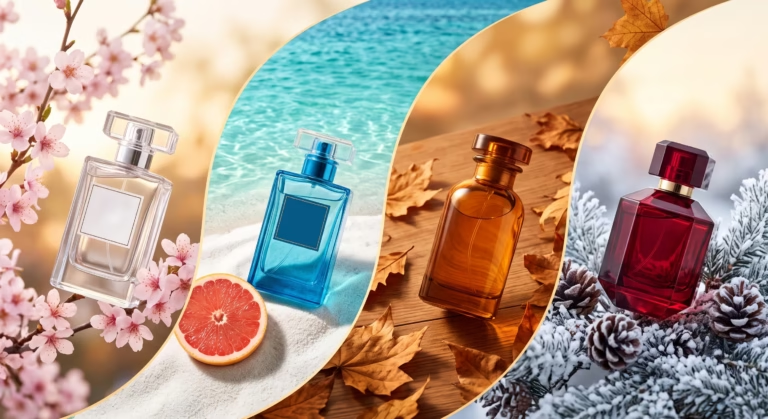
Humidity and heat amplify fragrance, while dry, cold air suppresses it. If you are traveling from a cold climate to a tropical one, a fragrance that feels perfectly balanced at home might become cloying in the humidity. To master seasonal and climate transitions, read our guide on adapting your routine for seasons and occasions.
How to Test Perfume by Lifestyle Requirements
You cannot accurately evaluate a perfume by lifestyle fit by spraying it on a paper strip in a department store. The bright lights, competing scents, and rush of the retail environment distort your perception. You must test fragrances in the wild.
Purchase a 2ml sample vial and wear it for three full days in the environment you intend it for. Wear the office scent to your actual office; wear the gym scent to your actual gym. Pay attention to how it makes you feel at hour one, hour four, and hour eight.

Key Takeaways
- Context is everything: Choose your fragrance based on the physical environment and temperature you spend the most time in.
- Respect the office: Stick to vetiver, iris, and clean musks in corporate settings, avoiding heavy projection.
- Adjust for heat: Active lifestyles demand light concentrations (EDC, EDT) and fresh, aquatic notes to prevent suffocating sillage.
- Express yourself creatively: If your lifestyle allows, use niche and unconventional scents as a form of personal expression.
- Test in reality: Always test a fragrance on your skin, in the actual environment where you plan to wear it, before committing to a full bottle.
If you’re ready to refine your routine further and master the art of scent application, we invite you to explore our comprehensive guide to perfume and fragrance fundamentals to deepen your understanding without the marketing hype.
Frequently Asked Questions
What is the best way to choose a perfume by lifestyle?
The best method is to track where you spend the majority of your week. If you are in an office 40 hours a week, invest your budget in an elegant, low-projection, office-safe fragrance. Match your heaviest investment to your most frequent environment.
Can I wear my evening perfume to the office if I spray less?
You can, but it is rarely ideal. Heavy evening perfumes are designed with base notes like oud, heavy amber, and rich vanilla that project intensely even with a single spray. It is better to choose a fragrance structurally designed for close quarters.
How do I find a gym safe perfume?
Look for terms like “Eau Fraîche” or “Sport” on the label. These are typically lower concentration formulas heavily weighted with citrus, mint, and aquatic notes. They are designed to evaporate quickly rather than clinging to sweaty skin.
What is a skin scent?
A skin scent is a minimalist fragrance that sits very close to the body with almost no projection. They often utilize synthetic molecules like Iso E Super or Ambroxan to enhance your natural body chemistry, creating a “your skin but better” effect.
How should I pack travel perfume safely?
Never travel with a full-size glass bottle in your checked luggage. Use a high-quality travel atomizer (5ml to 10ml) to decant your fragrance, or purchase dedicated travel-sized rollerballs and solid perfumes to avoid leaks and TSA issues.
Why does my fragrance smell different at work than at home?
Air conditioning, ambient room temperature, and your own stress levels can alter how a fragrance develops on your skin. A warm, humid bathroom at home will make a scent bloom differently than a dry, air-conditioned corporate office.
Is it okay to have multiple signature scents?
Absolutely. Modern fragrance enthusiasts often build a “fragrance wardrobe” rather than relying on one signature scent. Having 3 to 5 scents tailored to different lifestyles—work, weekend, evening, and active—is highly practical.
Does perfume expire if I don’t use it often?
Yes, perfume can oxidize and expire, usually within 3 to 5 years. If you only wear fragrance occasionally, buy 10ml travel sizes or 30ml bottles rather than large 100ml bottles to ensure you finish them before the top notes sour.